Compare quantities before comparing prices
Bring the quantities onto the same basis before deciding which pack costs less.
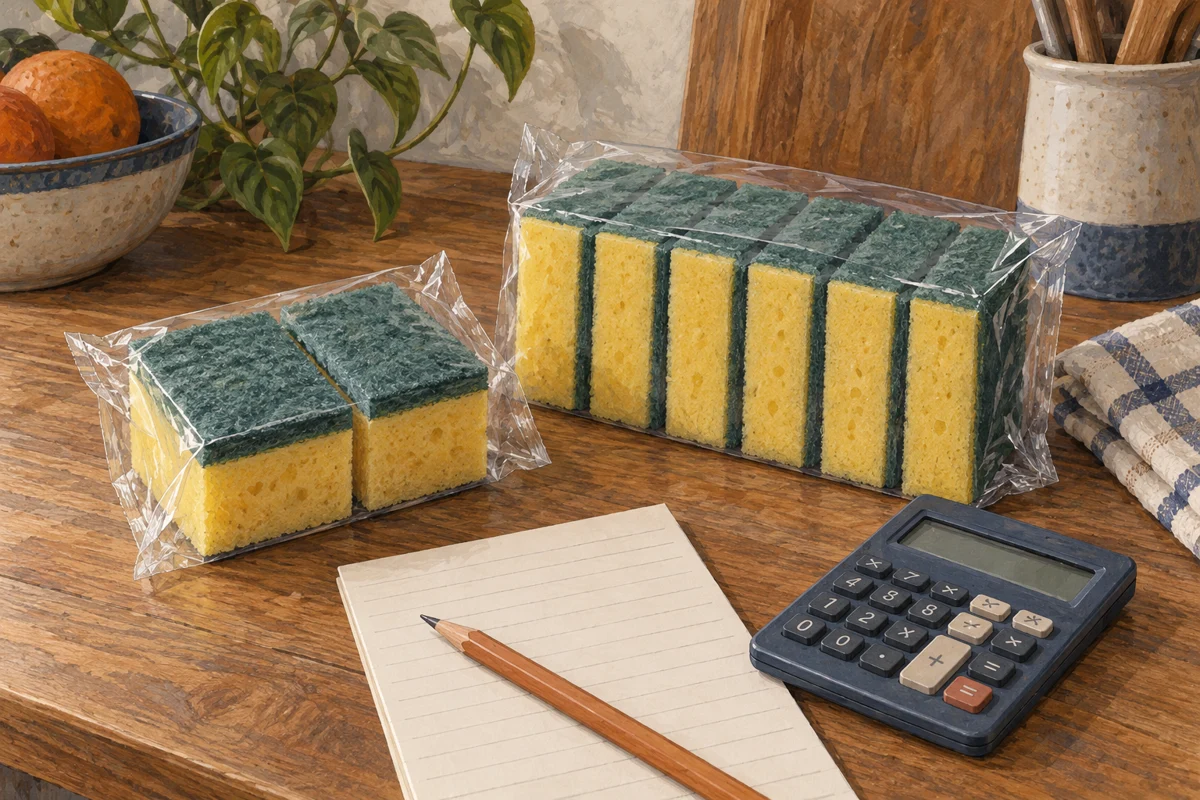
Choose a useful unit
Two packs can have similar prices and very different contents. For identical consumable goods, a price per item, per hundred grams or per litre can make the comparison clearer. Use the same unit for both packs and check whether the stated quantity is net contents rather than packaging weight.
For example, a hypothetical pack of four identical cloths at 240 rupees costs 60 rupees per cloth. A pack of six at 330 rupees costs 55 rupees per cloth. That arithmetic shows a lower unit price, but it does not establish that six cloths are the right purchase for your household.
Make sure the items are comparable
A smaller cloth, thinner sponge or different refill concentration can make a simple per-piece calculation misleading. Compare dimensions, material and intended use before treating the units as interchangeable. A larger bottle of a diluted product is not necessarily equivalent to a smaller concentrated one.
Bundle counts also need care. A set might count lids, handles or accessories as separate pieces. Use the number of complete useful items when that is the comparison you intend. If the listing does not make the contents clear, the apparent unit price is not yet trustworthy.
Delivery charges can change a small order's result. Add any unavoidable order-level charge when comparing the amount you will actually pay, while keeping the calculation transparent. Do not spread a delivery fee across imaginary future purchases just to make a bundle look cheaper.
Quantity has a practical limit
A lower unit price is useful only if you can store and use the quantity. Check available space and any expiry or deterioration concerns relevant to the product. Buying more than you need can tie up cupboard room and create waste without improving the household's routine.
For durable goods, price per item is only one part of the decision. A pair of well-fitting containers may be more useful than a large assortment that does not fit the shelf. The calculation should clarify a choice, not replace the questions about fit and function.
Write the comparison in a short note if the numbers are awkward. Once the quantities are on the same basis, the difference is often small enough that delivery convenience or the more suitable size becomes the deciding factor.