What an insulated flask can and cannot promise
Temperature-retention claims describe conditions; they do not replace the way a flask is filled and used.
Read beyond the number of hours
A flask may advertise a long retention period, but a headline figure is not a promise that every drink stays at the same temperature in every situation. Starting temperature, fill quantity, surroundings and repeated opening can affect use. Read the conditions supplied for the specific product rather than comparing only the largest number on the box.
Vacuum insulation slows heat transfer; it does not actively heat or refrigerate the contents. Milton's explanation of thermosteel bottles describes that insulating construction. Treat the flask as one part of handling a drink appropriately, not as a substitute for food-safety guidance or a reason to keep a perishable beverage indefinitely.
Decide how the drink will leave
A narrow direct-drinking opening, a screw cap and a pour-through stopper suit different routines. At a desk, removing a simple cap may be unremarkable. On a journey, a cup lid can be useful but introduces another piece to keep clean and a place for drips. Check whether the lid is actually intended as a cup.
If the drink will be hot, consider how you will pour or sip without rushing. A flask can keep liquid hotter than expected. Follow the product's filling limits and operating directions, and never assume that an outside surface that feels cool means the contents are ready to drink.
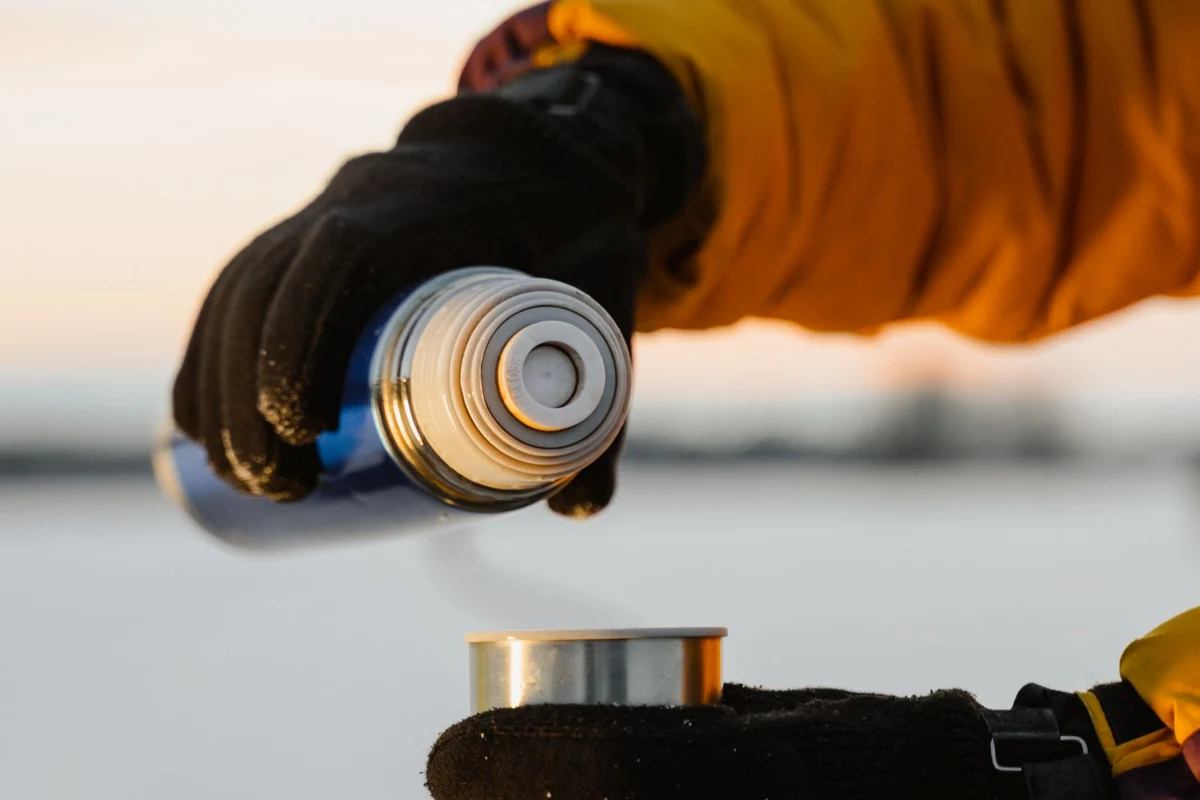
Look closely at the stopper's channels. A mechanism with several hidden paths may be more demanding to clean than a plain cap. Ask which components may be removed and how they should be put back. A closure that cannot be reassembled confidently is a poor match for daily use.
Fit the actual serving quantity
A very large flask can be heavy and awkward for a single cup. A small one may require refilling before a long outing. Think about the amount you normally use, then compare empty weight, overall dimensions and the filled load. The capacity is not a direction to fill beyond the maker's marked level.
For shared use, decide whether the opening and pouring arrangement keep handling simple. A flask passed around several people needs a stable place to stand and suitable cups. Do not perch it at the edge of a desk because the base is wider than the available space.
A desk flask and an outing flask
For a flask that stays upright on a desk, a simple pour and an easy-to-clean stopper may matter most. The weight is less important after arrival, but the base must fit the available space without being nudged by a keyboard or papers. A separate cup also needs a stable place; the flask should not sit at the desk edge merely to make room for it.
For a flask carried on a bus or walk, closure permissions, filled weight and bag fit become more prominent. Check whether the product is intended for that orientation and movement. A model designed as an upright serving flask should not be assumed leakproof when laid in a bag. Protect belongings while following the manufacturer's carrying directions.
These two uses can point to different products even at the same capacity. Write down where you will open it, whether you will pour into a cup and how you will wash it at the end of the trip. A large retention claim cannot answer those questions. If one flask must serve both settings, choose around the more demanding journey rather than the easier stationary use.
Cleaning is part of the performance
Read which drinks the maker permits and the recommended washing method. Do not apply a household cleaning recipe without checking compatibility with the interior, seals and stopper. Follow instructions about drying and storage, including whether to leave the closure off when not in use.
If the flask leaks, has damage or seems to have lost its insulating performance, consult the manufacturer. A new stopper may be appropriate in some cases, but a near-fitting replacement can create another problem. Keep the model details and ask about genuine parts before discarding a body that may still be serviceable.
When comparing two flasks, put the closure, cleaning access and weight alongside the retention claim. Those are the features you will encounter at every fill and every wash, long after the packaging has gone.