Leave room when choosing freezer containers
Choose the portion, the permitted material and the space left for expansion before filling a box.
Freezer-safe is a specific permission
A food container suitable for a cupboard or refrigerator is not automatically intended for freezing. Check the maker's freezer-use instructions for both body and lid. Glass, plastic and flexible packaging can have different restrictions, and a matching appearance does not establish the same temperature range.
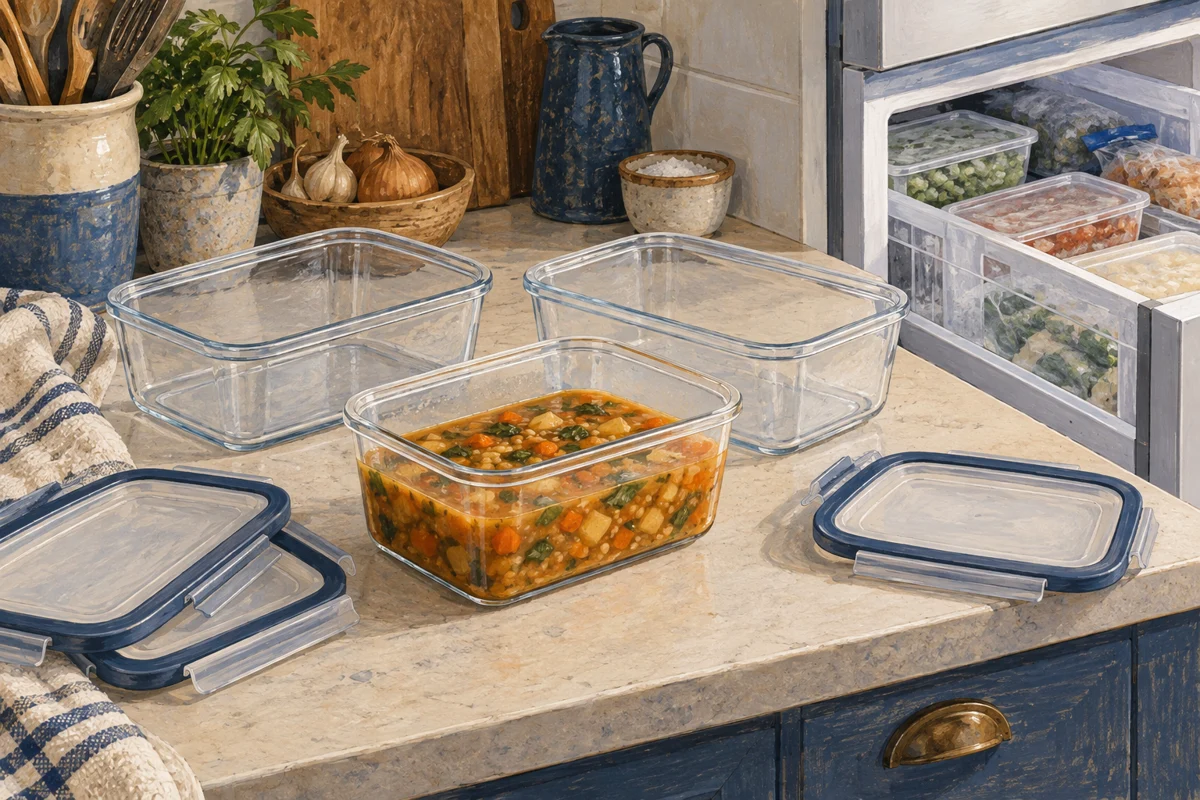
Follow the container and recipe guidance about headspace, particularly for liquids that expand. Do not fill a vessel to the rim just because the lid can still be forced on. The correct allowance depends on the contents and container; a single invented gap is not a rule for everything.
Freeze the quantity you will want later
Think about the next meal rather than the size of today's leftovers. A large block may be inconvenient when only one portion is needed. Several smaller containers use more lids and shelf space, but they can make later handling simpler. Choose sizes connected to actual use rather than a uniform set bought for appearance.
Check the freezer drawer's internal dimensions and opening clearance. A box may fit on the base yet catch when the drawer closes. Stack only in a stable arrangement permitted by the containers, leaving room to retrieve items without forcing frozen lids against one another.
Label the contents and date in a way that stays readable under the intended conditions. Include details that distinguish similar meals. A frosted rectangular box rarely reveals enough information by sight, and a label saying food is not a useful replacement for memory.
Read the freezer as a small inventory
A container system should let you see what is available without leaving the freezer open for a long search. Put frequently used portions where they can be reached directly, and keep a brief list for food stored farther back. The list does not need every detail; contents, portion count and date may be enough for your routine.
If you freeze both ingredients and finished meals, give them distinguishable labels or positions. Two similar boxes can require very different preparation later. Include information that will matter at the next opening, rather than assuming you will recognise the contents through frost. Keep any relevant ingredient or allergen information available when the original packaging is gone.
When buying more containers, look at which ones are repeatedly empty and ready to reuse. Those sizes are doing useful work. A larger box that has remained untouched for months may indicate a portioning problem rather than a need for another matching container. Adjust the next batch's size instead of extending the same pattern across the freezer.
Keep the handling chain intact
Freezing does not undo earlier poor handling. Follow reliable food-safety guidance for cooling, freezing, storage and thawing the particular food. USDA's freezing guidance explains that freezing affects microbial activity but does not make every previously mishandled item safe. A suitable box is only one part of the process.
For reheating, check the next appliance separately. Freezer permission does not automatically mean microwave or oven permission. Follow the manufacturer's directions for temperature transitions, especially with glass, and do not move a frozen container directly into heat unless that exact use is authorised.
Inspect the box after use for cracks, damaged clips or a poor seal. Replace parts correctly rather than forcing a brittle lid into place. Let it return through the cleaning and drying routine before filling it again.
A few well-labelled portion sizes can be easier to manage than a freezer full of mixed tubs. Make a short note of what is stored near the back and use that record when planning meals, so the new containers do not simply make forgotten food stack more neatly.