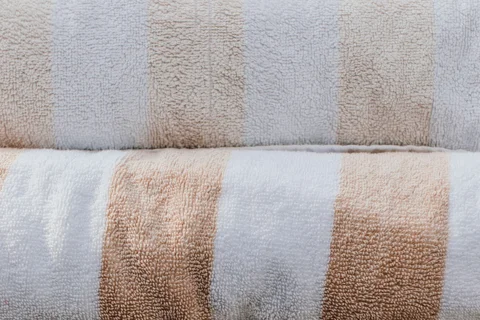
Keep strong colours apart on the first wash
A first wash is a good time to keep unfamiliar dyes away from pale linen, while following the item's own instructions.

Do not let a colour name make the decision
A deep red napkin beside a pale towel is an obvious pairing to question, but colour transfer is not limited to one shade or fabric. Read the care instructions on a new textile before adding it to a mixed load. If the maker says to wash separately or with similar colours, treat that as part of the purchase.
The printed pattern matters as well as the background. A mostly white cloth with dark borders still contains strong colours. Check whether its construction has specific instructions rather than assuming it belongs with plain whites. Decorative trims can also have different behaviour from the main cloth.
Keep the first load simple
Use the permitted wash conditions and avoid adding unfamiliar stain treatments. A first wash with a complicated mixture of new fabrics makes it difficult to identify the source if something changes. Keep a record of the label until you know the item behaves as expected in your routine.
Colour-catching products are not a reason to ignore separation instructions. They may be marketed as laundry aids, but they do not turn every combination of dyes and fibres into a suitable load. Follow both the textile label and any laundry product's directions.
Remove wet items promptly when the cycle is finished, as their instructions allow. Do not leave a damp dark cloth pressed against pale linen in a basket while waiting for drying space. Plan the rack before starting the wash, especially during humid weather when several loads may be competing for it.
If a mark appears
Avoid immediately tumble-drying or ironing the affected piece while deciding how to address the mark. Check the textile manufacturer's advice and any suitable colour-run treatment's instructions, including exclusions. Do not mix cleaning products or apply bleach simply because the affected cloth was originally white.
For valuable or delicate linen, ask a textile-care professional rather than experimenting repeatedly. Photograph the label and describe what was washed together. Specific information is more useful than the general description that a dark item was involved.
Once a textile has been washed several times, continue to follow its care label rather than assuming it can now join every load. A simple sorting system for pale, strong-coloured and specially cared-for household linen is easier to maintain than trying to repair avoidable transfer afterwards.